Weapons Collection

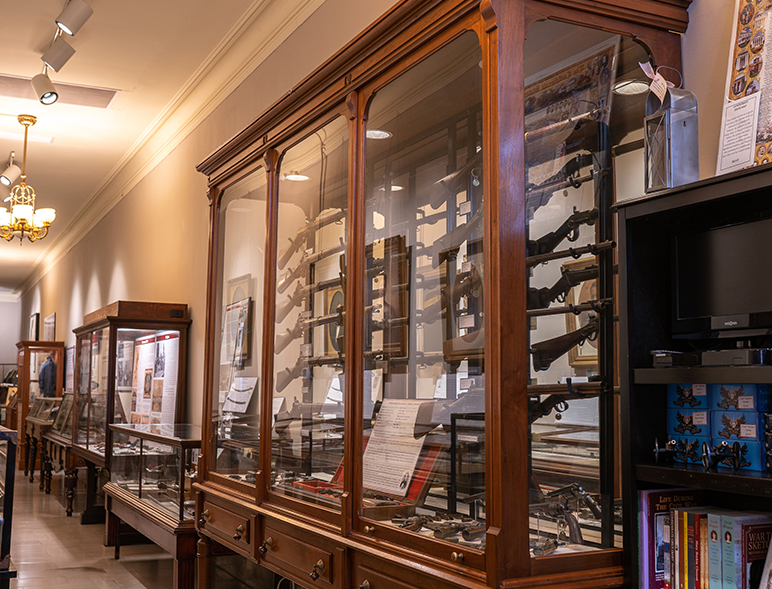
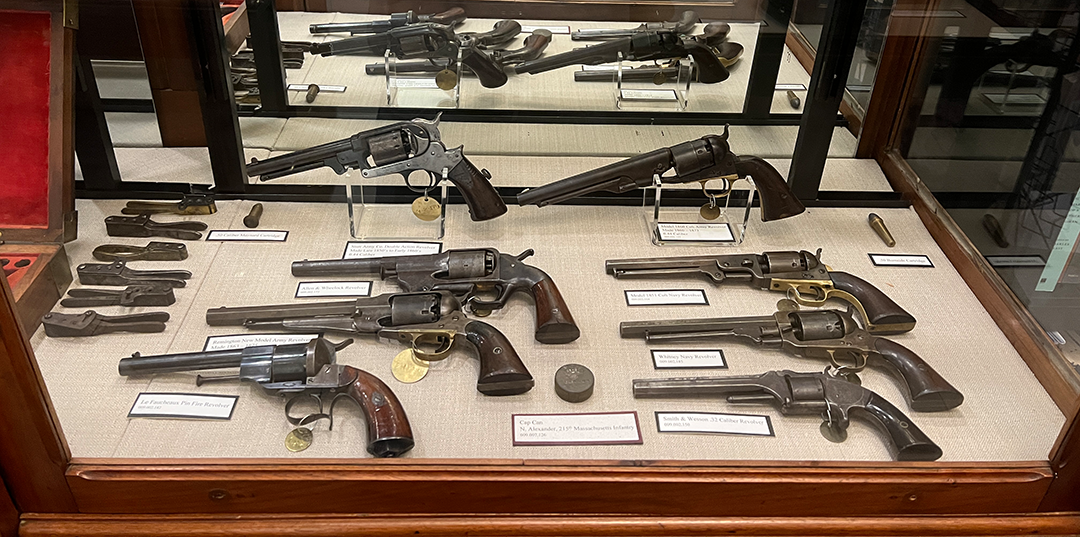
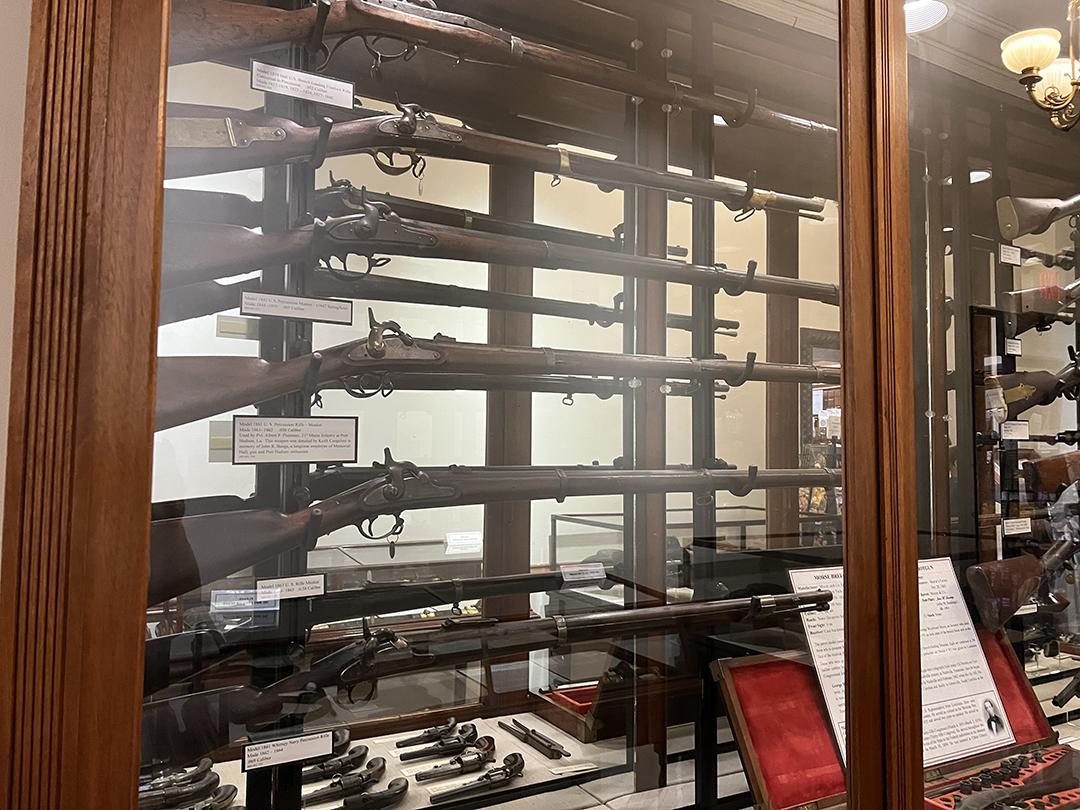
The Civil War was fought as weaponry and tactics were evolving. Rifled cannon and rifled muskets, capable of sending their deadly projectiles farther and faster while inflicting maximum damage, were improvements over smoothbore arms. Many swords, especially those made in New Orleans were ornate and worn more for status and prestige than for use in combat. Pistols and carbines produced multiple chances to fell an opponent. Also on display is an example of an early hand grenade. Samples of all of these including many rare types can be seen in Memorial Hall’s extensive collection of Civil War Firearms and Edged Weapons. Click on images to enlarge.

Item Information The LeMat Revolver

This .42 caliber LeMat revolver has a nine-chambered cylinder and weighs about four pounds. What makes this revolver unique is the addition of a second smoothbore barrel, of approximately .63 caliber, underneath the barrel. This larger barrel was designed to fire buckshot. The top of the hammer was fitted with a pivoting striker that could be rotated to fire the .42 caliber rounds or changed to fire the lower, larger barrel.

This percussion revolver was designed by Dr. Jean Alexandre Francois LeMat, of New Orleans. LeMat was assisted in this enterprise by P. G. T. Beauregard, one of the Confederacy’s well known generals. These revolvers were manufactured from 1856 to 1865, with less than 2,900 being produced. They were made in Liege, Belgium, Paris, France, and London, England and proofed in Birmingham, England. Many were purchased by the Confederacy and used by such famous high-ranking Confederate officers as J. E. B. Stuart and General P.G.T. Beauregard.


009.002.131


Back to Weapon Items Gallery
Ketcham Hand Grenade
The grenade was used in one-, three-, and five-pound sizes. The United States Government purchased a total of over 93,000 of this type of grenade. This percussion grenade had to land point first on the plunger, which was kept from striking the cap on the nipple by a friction string in the side of the plunger hole. To insure this, the wooden tail with cardboard fins was placed into a hole at the upper end. There are records that indicate that some grenades were caught in blankets, etc. and were thrown back by the Confederate troops. They were used in Virginia, Kentucky, Louisiana, Mississippi, and also aboard some United States ironclad gunboats.

009.010.030

Back to Weapon Items Gallery Item Information
Gun Tools
Gun tools were carried by soldiers to make necessary repairs to their weapons. Two worms, cone wrench and a small knife are pictured.
009.010.022


Enfield Bullet Mold
Civil War soldiers carried bullet molds like this one to melt spent lead rounds and shape Minie balls to make their own ammunition.
009.010.035


Back to Weapon Items Gallery Item Information
Item Information Back to Weapon Items Gallery Bowie Knife
Manufactured by W & S Butcher, Sheffield, England .
The blade is marked “of the best quality”
Handle: One piece stag horn grip with brass lower guard and mount. It has a brass pommel cap.
“Bowie” style blade. False edge extends back four inches.

009.007.106
Sword of Captain Henry F Wade, Jr.
Company D, 8th Louisiana Heavy Artillery

Wade was the commander of the Crescent Artillery Louisiana Militia.
On March 24, 1862, just before the fall of New Orleans, he became Captain of Company D, 8th Louisiana, Heavy Artillery stationed in Vicksburg in water defenses. The water guns were divided into three commands and the 8th manned the center batteries immediately in front of the city. On the evening of July 3rd, they fired the last cannon from the river batteries. After the siege of Vicksburg, he had no guns and was assigned command of Company B, 39th Mississippi Infantry in February 1864.

Sword made by Thomas and Griswold and Company New Orleans, Louisiana
Henry Thomas, Jr., and Arthur Breeze Griswold

009.004.224
Item Information Back to Weapon Items Gallery
Tarpley Carbine This mint condition Southern made .52 caliber carbine was manufactured in Greensboro, North Carolina for the State of North Carolina. This Carbine was designed to be made by hand with the least amount of machinery. Its crude construction and tendency to fail made this weapon less desirable to cavalry troops, but in the final years of the war any weapon was pressed into service. This was the only Confederate firearm to also be available
on the civilian market. The serial number on this particular weapon is No. 40.

009.001.130B


Item Information Back to Weapon Items Gallery
has been added to the cart. View Cart
error: Content is protected !!